
The Neomove device: acting at the biomechanical source of MSD risk
Addressing the biomechanical source of MSD risk requires going beyond simply reducing work-related stress.
MSDs, or musculoskeletal disorders, often occur when the body is subjected to repeated strain. Preventing them cannot be limited to reducing this strain.
It is also a question of maintaining the functional capacity of employees to absorb them over time.
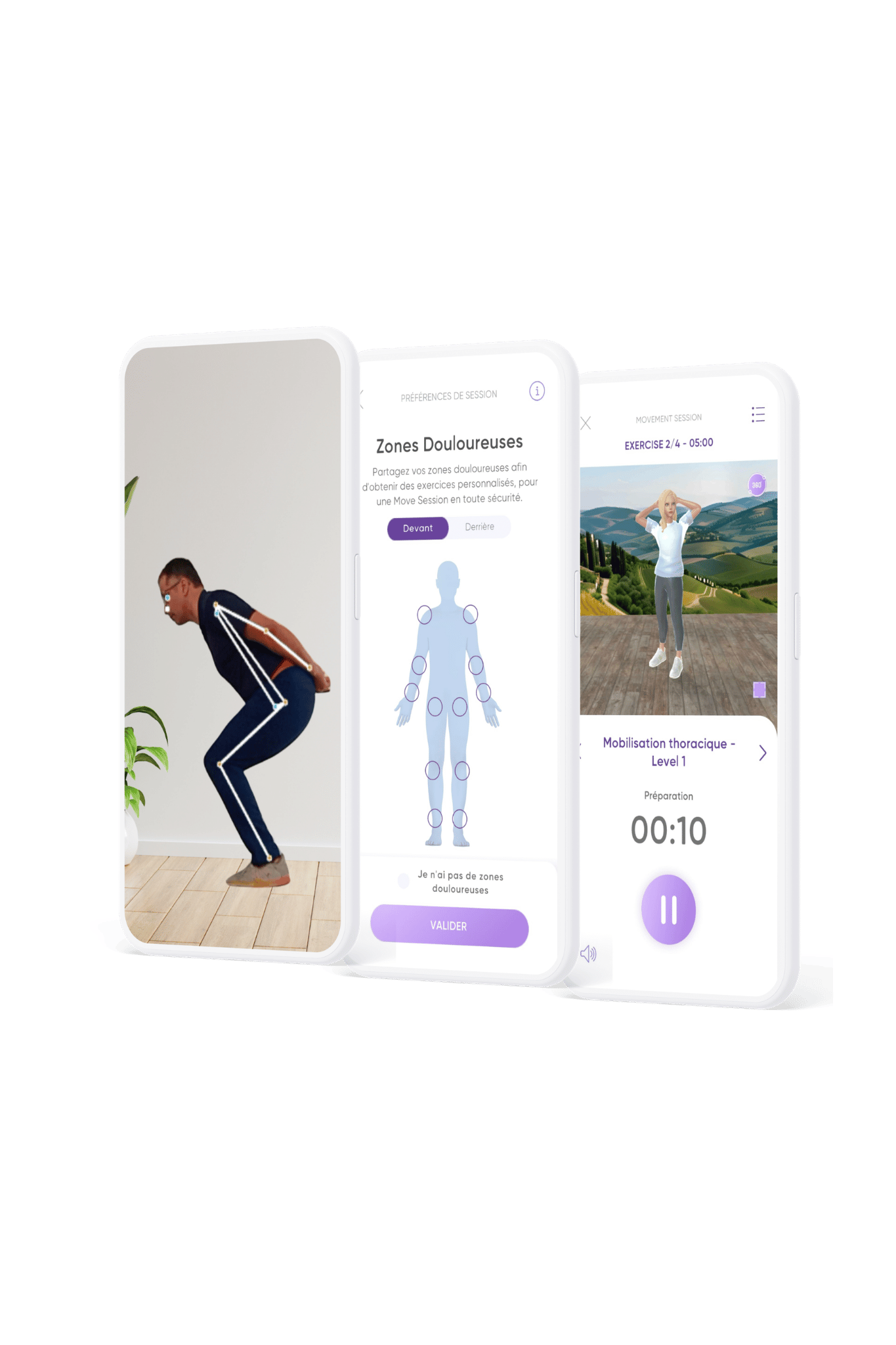
Neomove is a digital device designed to act on this individual lever, without replacing ergonomic measures, while producing usable data in a structured prevention approach.
Sustainable prevention relies on two complementary levers:
address professional constraints
maintain the body's ability to absorb them
Ergonomics, workstation design, and training in proper movements and postures are essential.
They reduce exposure to risk.
Neomove does not replace job analysis or work organization.
Reduce constraints and maintain functional capacity
The application acts on the other variable in the system: individual functional capacity.
When useful mobility decreases, motor control deteriorates, and compensations set in:
certain areas become overloaded
gestural variability is reduced
local fatigue builds up
the pain appears
MSDs result from a dynamic imbalance between constraints and capabilities.
Neomove focuses specifically on this second lever.

The balance between constraints and capabilities takes on its full meaning when it is incorporated into a continuous management approach.

Movement as a biomechanical and neuromotor lever
The movement operates on two complementary levels.
Mechanics
Useful joint mobility
Segmental stability
Better distribution of loads
Neuro-motor
Coordination
Muscle synchronization
Efficiency of movement
Better tolerance to prolonged postures

In office and hybrid environments, sedentary lifestyles exacerbate this imbalance.
According to the European Agency for Safety and Health at Work (EU-OSHA), an increase of more than two hours of sitting per day is associated with a significant increase in the risk of musculoskeletal disorders.
The problem is not just posture. It is the gradual loss of adaptability.
The goal is not to freeze an ideal posture. It is to restore sufficient adaptive capacity to absorb the real stresses of work.
The Move Test: analyzing movement
to act with precision
The Move Test is a digitalized functional assessment based on standardized tests and motion tracking analysis.
Without sensors or specific equipment, it can identify:
Mobility limitations
Functional imbalances
Stability deficits
Alterations in motor control
The analysis is based on a reproducible assessment grid, focusing on the major functional areas: neck, shoulders, arms, feet, knees, hips, and back.
This is not a medical diagnosis.
It is a prevention-oriented functional analysis tool designed to be repeated over time in order to monitor changes in abilities.
From analysis to targeted action
The results of the Move Test do not produce an abstract score.
They trigger a structured functional orientation.
Each profile generates:
Prioritization of risk areas
Prioritization of areas of focus
An individualized protocol tailored to the actual level of mobility and stability
The sessions offered are not generic.
They address the imbalances identified during the assessment.
The selected exercises aim to correct the imbalances identified during the Move Test:
Regain sufficient mobility to perform everyday tasks with minimal compensation
Stabilize certain areas that are repeatedly stressed
Making movements more efficient and less costly in terms of tension
The recommendations address the limitations actually observed during the functional assessment.
Progress is based on measured data, not on a standard program that is identical for everyone.
Actions integrated into actual work
The device includes:
10-, 20-, or 30-minute sessions
active breaks to combat sedentary lifestyles
zone-specific protocols
recovery sequences
The formats are designed to fit into professional days without adding organizational complexity.
The objective is straightforward: to maintain functional capacity in the face of the actual constraints of the position.
But the body's capacity is not limited to working hours.
By restoring mobility, stability, and motor control, the effects extend beyond the strictly professional sphere and contribute to greater tolerance of everyday demands.
Prevention is no longer a one-off action.
It is becoming an integrated and sustainable practice.
The operational integration procedures are detailed on the MSD prevention deployment page.
From individual action to structured prevention
On a collective scale, the anonymized aggregation of data produces usable anonymized indicators:
Activation rate
Change in reported fatigue
Distribution of the most frequently reported areas of tension
Changes in mobility and stability capabilities...
Progress observed between two successive assessments
These data, displayed by age group and type of major activity, enable the evolution of functional risk over time to be objectively assessed without exposing individual data, and are fully meaningful in the dashboard, where they contribute to the DUERP and PAPRIPACT processes.
For organizations with fewer than 25 employees, a standalone offer without management is available.