
Preventing MSDs in the workplace: understanding the mechanisms and structuring sustainable action
Musculoskeletal disorders are now the leading cause of occupational illness in France.
They affect all sectors of activity, from industry to the service sector, and represent a major human, organizational, and economic challenge.
Their appearance is often silent. The first signs are subtle. However, the impact on collective performance can be significant.
Understanding the mechanisms of MSDs is essential for implementing truly effective and sustainable MSD prevention measures in the workplace.
MSDs are conditions linked to a gradual imbalance between occupational demands and physical capabilities. Effective prevention combines ergonomics, work organization, maintenance of functional capabilities, and continuous risk management.
Musculoskeletal disorders: definition
Musculoskeletal disorders, or MSDs, refer to a range of conditions affecting the muscles, tendons, nerves, and joints.
Musculoskeletal disorders, or MSDs, refer to a range of conditions affecting the muscles, tendons, nerves, and joints.
They appear when professional demands exceed the body's ability to adapt.
Unlike a workplace accident, MSDs result from repeated or prolonged exposure. They develop gradually.
Nearly half of them result in permanent sequelae that can lead to long-term disability or exclusion from the workforce.
Low back pain is also the leading cause of disability before the age of 45.
These figures illustrate the scale of the phenomenon in terms of health and employment.
According to data published by the French health insurance agency (Ameli), musculoskeletal disorders account for approximately 87% of recognized occupational illnesses in France.

Which areas of the body are most affected by MSDs at work?
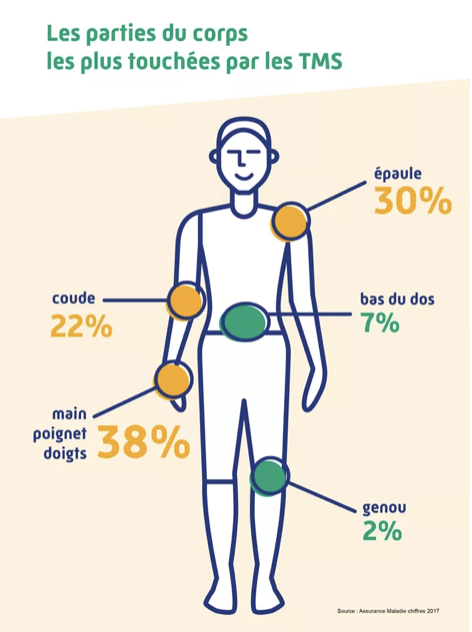
Musculoskeletal disorders mainly affect the upper limbs and the lumbar region.
In France, the most commonly recognized conditions are:
Carpal tunnel syndrome in the wrist (37%)
Rotator cuff syndrome in the shoulder (31%)
Lateral epicondylitis of the elbow (21%)
Low back pain (7%)
These locations are not random.
They correspond to the areas most subject to wear and tear in professional environments, whether:
Fine repetitive movements
Handling
Prolonged computer use
Maintained static postures
Or efforts made to an extreme degree
The upper limbs thus bear a large part of the repeated mechanical stress, while the lumbar region plays a central role in maintaining posture and absorbing loads.
This breakdown highlights the importance of an integrated preventive approach, combining task analysis and capacity maintenance.
What are the main risk factors for MSDs in the workplace?
MSDs at work are rarely caused by a single factor.
They most often appear as a result of a combination of biomechanical stresses, the intensity, repetition, and duration of which determine the level of exposure (INRS).
The main physical factors identified are:
Constraining postures
Keeping a joint outside its comfort zone causes prolonged compression and stretching. When these postures are maintained or repeated, the tissue's ability to adapt decreases.
Physical strength and effort
The intensity of the effort, the joint position, and the gripping technique influence the mechanical load exerted on the muscles and tendons. Efforts performed at extreme ranges of motion or without sufficient recovery increase the risk.
Repetition of movements
Frequent repetition of the same movement limits recovery phases and promotes cumulative fatigue.
Exposure time
The longer a demanding task is performed, the greater the risk, particularly in the absence of alternation or variability in movement.
These constraints act cumulatively.
Their combination accounts for the majority of biomechanical exposures that cause MSDs.
Organizational and psychosocial factors
Biomechanical constraints never occur independently of the work context.
Work organization can amplify the intensity of exposures or reduce recovery margins.
Several organizational factors are recognized as aggravating factors:
A sustained or imposed work pace
Severe time constraints
Atypical or irregular working hours
Insufficient breaks or recovery time
Low autonomy in performing tasks
A lack of recognition or support
These factors influence muscle tension, cumulative fatigue, and movement variability.
When there is less room for maneuver, postures become more constrained, movements more repetitive, and recovery times insufficient.
The risk therefore does not depend solely on the physical demands of the job.
It also depends on how the work is organized, planned, and managed.
The prevention of MSDs in the workplace cannot therefore be limited to ergonomic design.
It must incorporate an analysis of rhythms, workloads, and organizational methods.
The key mechanism: an imbalance between constraints and capabilities
Musculoskeletal disorders (MSDs) occur when occupational stresses exceed the body's ability to adapt over time.
Two dimensions interact constantly:
Constraints
Postures, repetition, physical strain, task organization, pace, lack of variation in movements.
Capabilities
Mobility, joint stability, muscle coordination, recovery, range of motion.
This imbalance occurs when sustained exposure to stressors is not offset by adequate capacity (e.g., insufficient recovery, reduced mobility, cumulative fatigue). Under these conditions, tissue tolerance gradually decreases, even if the workstation remains unchanged.
This pattern of MSD onset highlights two complementary levers:
Reduce constraints through ergonomic analysis and the adjustment of workstations and tasks.
Maintain or increase functional abilities through training, physical preparation, and recovery strategies.
This logic of balance is a fundamental part of structured prevention approaches, as it directly links task analysis to human physiology.
Some companies choose to incorporate a movement-based prevention program that allows these abilities to be assessed and maintained over time.
Why does MSD prevention in the workplace need to be structured?
MSDs are progressive and multifactorial phenomena.
A one-off action, such as a single training course or an isolated adjustment, cannot control a risk that is ongoing and depends on multiple factors.
Structured prevention is based on several complementary dimensions:
a thorough analysis of physical and organizational constraints
action on the working environment and organizational arrangements
maintaining the individual capabilities of employees
monitoring risk indicators and actions over time
Without a structured framework, actions remain isolated, difficult to measure and evaluate, and the risk persists.
This structured approach is compatible with the employer's safety obligation and allows preventive measures to be integrated into existing processes.
Understanding how prevention management can contribute to the DUERP (Single Document on Occupational Risks)

Why are MSDs a major challenge for companies?
Their impact goes beyond the medical dimension alone. It is human, organizational, and economic.
Human impact
In the long term, MSDs can cause employees to experience:
Persistent pain
Functional limitations
Extended work stoppages
Incapacities or reassignments
They affect employees' career paths and their ability to maintain sustainable employment.
Organizational impact
The individual consequences collectively result in:
Team reorganization
Redistribution of tasks
Overloading of employees present
Loss of operational continuity
These imbalances undermine internal stability and overall performance.
A significant proportion of situations remain underreported, which underestimates the real impact from a statistical and organizational perspective.
In this context, it may be useful to objectively assess these impacts at the company level using an ROI simulator that calculates the cost of inaction in preventing MSDs.
Effective prevention then becomes a lever for organizational stability and sustainable performance.
Overall economic impact
According to estimates provided by the INRS, the average cost per case exceeds €21,000:
Direct expenses (compensation, care)
Organizational costs (replacement, training, administrative management)
Losses in productivity and performance
The financial cost is thus the accounting translation of a broader human and organizational impact.
What are the employer's legal obligations regarding MSDs?
The prevention of MSDs is part of the general safety obligation set out in the Labor Code.
This obligation is based on principles clearly defined by public authorities (Ministry of Labor).
The employer must:
Assess occupational risks
Formalize this assessment in the DUERP (single document for the assessment of occupational risks).
Implement appropriate preventive measures
Ensure regular monitoring of these actions
PAPRIPACT (action plan for the prevention of occupational risks and improvement of working conditions) formalizes the actions undertaken and their planning.
The prevention of MSDs cannot be a one-off measure. Like any active prevention approach, it must be structured, tracked, and reevaluated over time.
The three stages of MSD progression
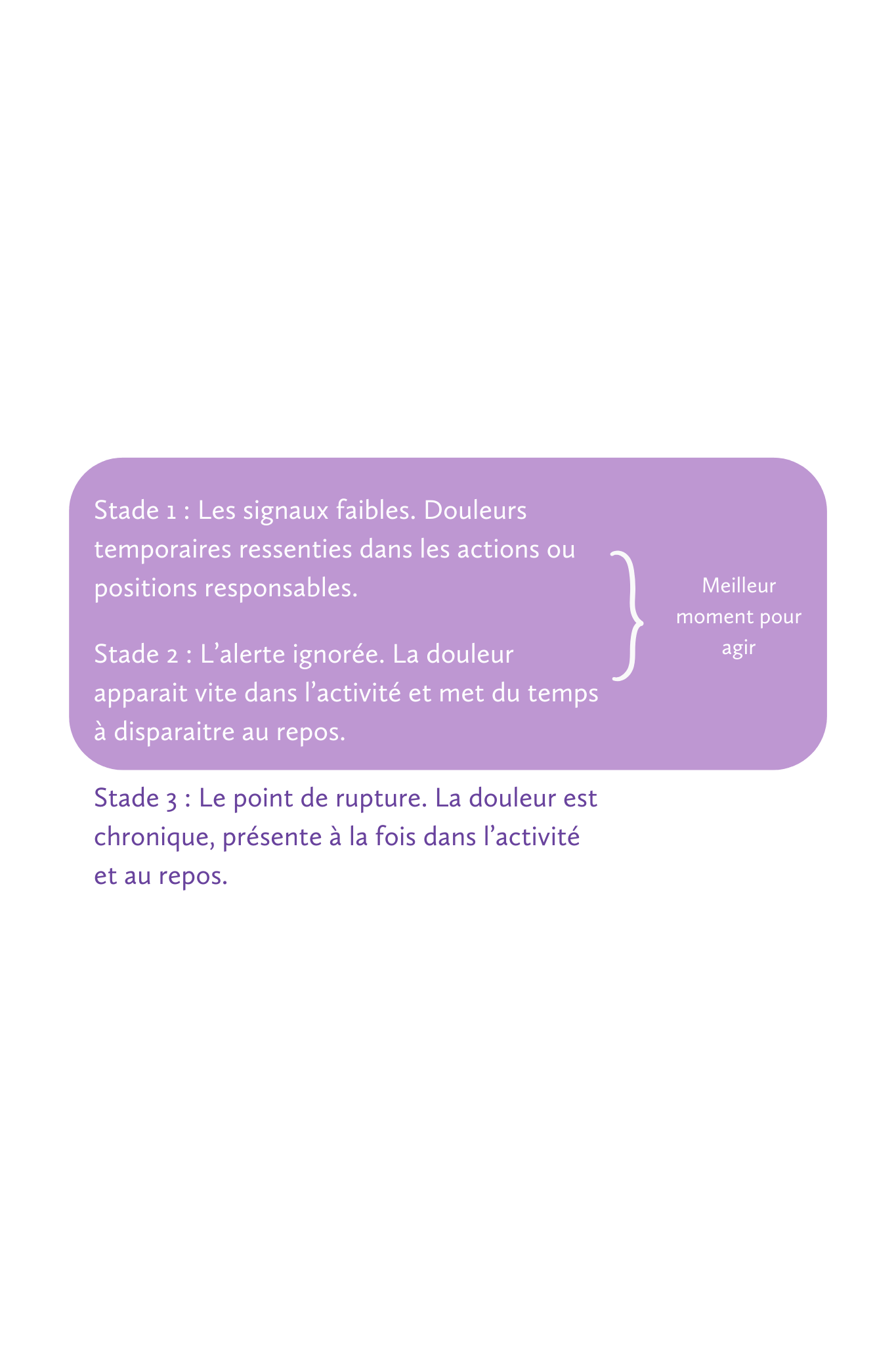
MSDs generally develop in three stages, which makes early prevention all the more important:
Stage 1: Primary prevention
The pain occurs during activity and disappears at rest.
Stage 2: Secondary prevention
The pain occurs more quickly and persists longer, often outside of periods of activity.
Stage 3: Tertiary prevention
The pain becomes chronic and may be present even at rest, often with functional limitations.
The later the intervention, the greater the human, organizational, and economic impact. Structured prevention can reduce the number of cases that progress to advanced stages.
How can effective MSD prevention be implemented in the workplace?
Effective prevention is based on a set of complementary actions:
Ergonomic improvement
Adapt workstations and tasks to limit excessive mechanical strain and reduce exposure to risk.Organizational adaptation
Structure work rhythms, incorporate recovery time, and encourage variability in movements.Team awareness
Develop a shared understanding of the mechanisms of MSDs and the role of movement in prevention.Maintaining functional abilities
Maintaining mobility, stability, and motor control so that the body can sustainably absorb occupational stresses.Monitoring and adjustment over time
Observe changes in indicators, analyze trends, and adjust actions based on the signals detected.
The goal is to maintain a balance between constraints and capabilities over time.
When a company combines action in the field with collective management, prevention becomes a long-term endeavor and feeds into existing regulatory procedures (DUERP, action planning).
Institutional references and official sources
The prevention of musculoskeletal disorders (MSDs) in the workplace is based on a regulatory framework and recommendations established by public bodies specializing in occupational health and the prevention of occupational risks. The following resources provide further information on the legal, methodological, and statistical aspects discussed on this page.
Prevention guides and resources
National Institute for Research and Safety (INRS)
Prevention of MSDs, risk factors, and methodological approaches:
https://www.inrs.fr/risques/tms-troubles-musculosquelettiques/prevention.html
Ameli – Health Insurance
Complete report on musculoskeletal disorders and national statistical data:
https://www.ameli.fr/assure/sante/themes/tms/comprendre-troubles-musculosquelettiques
Epidemiological data
Public Health France
Monitoring and data on work-related illnesses:
Regulations and obligations
Department of Labor
Prevention of musculoskeletal disorders and regulatory framework:
https://travail-emploi.gouv.fr/la-prevention-des-troubles-musculo-squelettiques-tms
Work organization
National Agency for the Improvement of Working Conditions (ANACT)
Work organization and integrated prevention:
FAQ: Preventing MSDs in the workplace
-
No. Tertiary occupations are also affected, particularly due to prolonged sedentary behavior and static postures.
-
Ergonomics affects the work environment.
Preventing MSDs in the workplace also involves maintaining employees' ability to adapt to constraints.
-
The DUERP structures risk assessment.
Without ongoing actions and dynamic indicators, prevention remains largely declarative.
-
Yes, by combining stress reduction, organizational adaptation, and maintaining functional capabilities.
MSDs are multifactorial, progressive, and costly.
Effective prevention of MSDs in the workplace relies on a sustainable balance between professional constraints and individual capabilities.
It must be continuous, measurable, integrated, and managed.
It is within this structure that sustainable control of musculoskeletal risk is achieved.